01
Pick a topic
Choose one of the Physical Education topics above or type your own, then pick your state. WACE, VCE, HSC, QCE and SACE each word their questions differently, and the paper follows yours.
02
Attempt it yourself
Exam-style questions with the mark allocation showing, so you know how much to write. You answer them — nothing is handed to you.
An athlete’s VO₂ max improves from 48 to 55 mL/kg/min after 12 weeks of training. Explain two physiological adaptations responsible, and evaluate what this means for their 10 km race performance. (8 marks)
03
Get it marked
Your answer comes back marked criterion by criterion in seconds — what you earned, what you half-earned, and what the examiner never saw.
5/8 · ✓ Identifies increased stroke volume as a central adaptation
04
Fix the gap
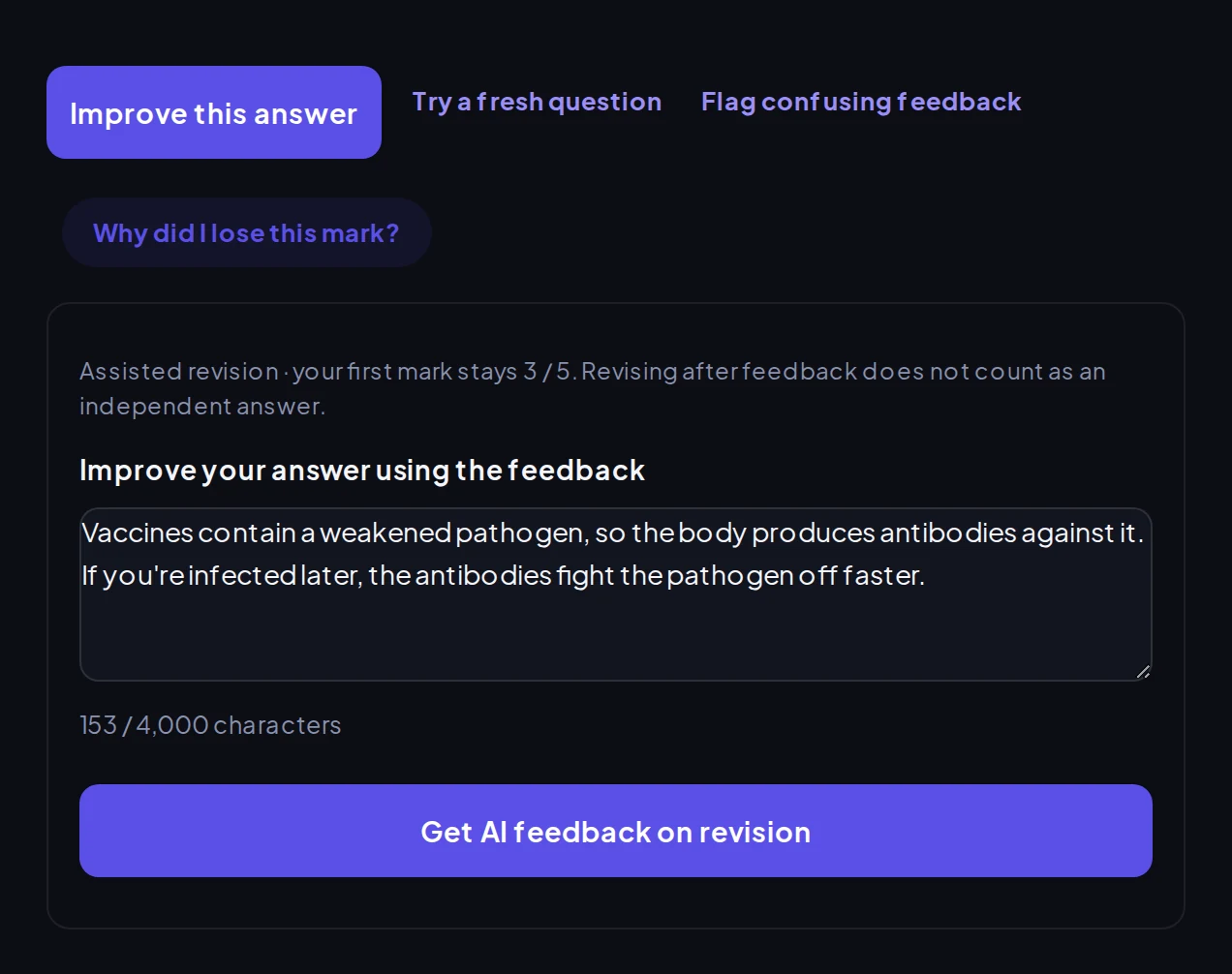
The topics you keep losing marks on come back around in your review until they're strong. That's the whole point.
the three energy systems and their interplay
Choose your system
WACEVCEHSCQCESACE
Then your topic
the three energy systems and their interplayacute responses to exercisechronic training adaptationsfatigue mechanisms and recovery
An athlete’s VO₂ max improves from 48 to 55 mL/kg/min after 12 weeks of training. Explain two physiological adaptations responsible, and evaluate what this means for their 10 km race performance. (8 marks)
Physical Education · VCE
Marked in seconds
✓ Identifies increased stroke volume as a central adaptation
✓ Identifies peripheral adaptations — capillarisation and mitochondrial density
△ Explains how each adaptation raises oxygen delivery or utilisation specifically
✕ Evaluates realistically — VO₂ max alone does not determine race pace; lactate threshold and economy also matter
Weak topics, resurfacing
the three energy systems and their interplay
acute responses to exercise
chronic training adaptations